By
Dr Nomcebo Serrah Mhlanga and Professor Okanga Boniface
Pretoria, South Africa, January, 2025
INTRODUCTION
Participatory-budgeting (PB) edifies effective municipal financial management. Participatory-budgeting is a deliberative and participatory democracy process through which local communities are engaged to participate in the deliberations and making decisions on how a portion of the municipal budget must be allocated across different priority projects (Haris & Shah, 2020:1). This improves effectiveness of municipal financial management. Financial management is the process of planning, organising, leading and controlling how municipal financial resources must be used across different programmes to achieve the desired municipal service delivery outcomes (Meltzer, 2015:389).
Effectiveness of such municipal financial management process is often edified by participatory-budgeting. PB aids local communities’ participation in critical budget allocation decisions. This enhances allocation of municipal financial resources according to programmes and projects of priorities and high rankings reflecting the critical dichotomous needs and preferences of a majority of local residents (Meltzer, 2015:389). It is through such approach that PB leverages minimisation of wastes as well as optimisation of the usually meagre municipal financial resources.
In turn, this aids implementation of as an array of different priority service delivery programmes as possible (Cabannes, 2015:257). Yet, it is not only through local communities’ participation in resource allocation decisions that PB spawns effective expenditure management. Instead, leveraged expenditure management also arises from local residents’ direct participation in the evaluation of how such allocated budgets are being utilised (Sangiev, 2015:96). Such evaluation aids identification and mitigation of incidents of corruption and financial mismanagement that often cause diversion of funds from PB projects to other areas.
In turn, this spawns wastes’ minimisation to spur effective municipal expenditure management. Improved municipal expenditure management catalyses the overall effectiveness of municipal financial management. Such a view echoes Cipolla, Afonso, Wittmayer, Serpa and Rach’s (2015:6) revelations that outcomes of studies on PBs in Brazil, Korea and United Kingdom imply PB influences effective expenditure management according to certain three levels. Such three levels encompass budget formulation and analysis, expenditure monitoring and tracking and service delivery monitory and evaluation.
Yet, as PB leverages municipal expenditure management at such three levels, it also tends to spur local residents’ capabilities to hold relevant municipal officials and politicians accountable and responsible for poor financial management practices and behaviours (Cipolla et al. 2015:6). Fear of consequences of being held accountable often lures most municipal officials to adhere to the requisite municipal financial management practices and behaviours. It is during such processes that PB edifies effective municipal expenditure management to bolster improved municipal financial management. Effective municipal financial management catalyses the municipality’s capabilities to deliver the required services to the population (Cipolla et al. 2015:6).
Even if it is true that improved municipal financial management leading to improved service delivery often delights local population, only a few studies seem to have examined how PB edifies expenditure management to bolster municipal financial management.
Instead, most previous studies focused only on evaluating PB processes’ effectiveness and their socio-economic impacts on local communities’ healthcare, water, energy and resource redistribution to respond to the previously marginalised population’s needs and preferences (Clement, 2019:6; Fyfe, MacMillan, McGregor, Hewitt & Callaghan, 2011:3; Govanhill Housing Association, 2011:5; Lin, 2010:70; Nabatchi, 2012:699). Though such approach undermines how PB can be optimised to bolster municipal expenditure management and subsequently financial management, it is not just such a gap that motivates this research. Instead, this research is also motivated by the fact that as compared to the Porto Alegre model in Brazil and United Kingdom’s Localism Act 2011 and “community grants” and “top-slicing” PB models, South Africa seems to lack a clear specific participatory-budgeting policy and law as well as PB model. This undermines effectiveness of most South Africa’s municipal PBs to integrate local communities and catalyse effective municipal expenditure management and financial management.
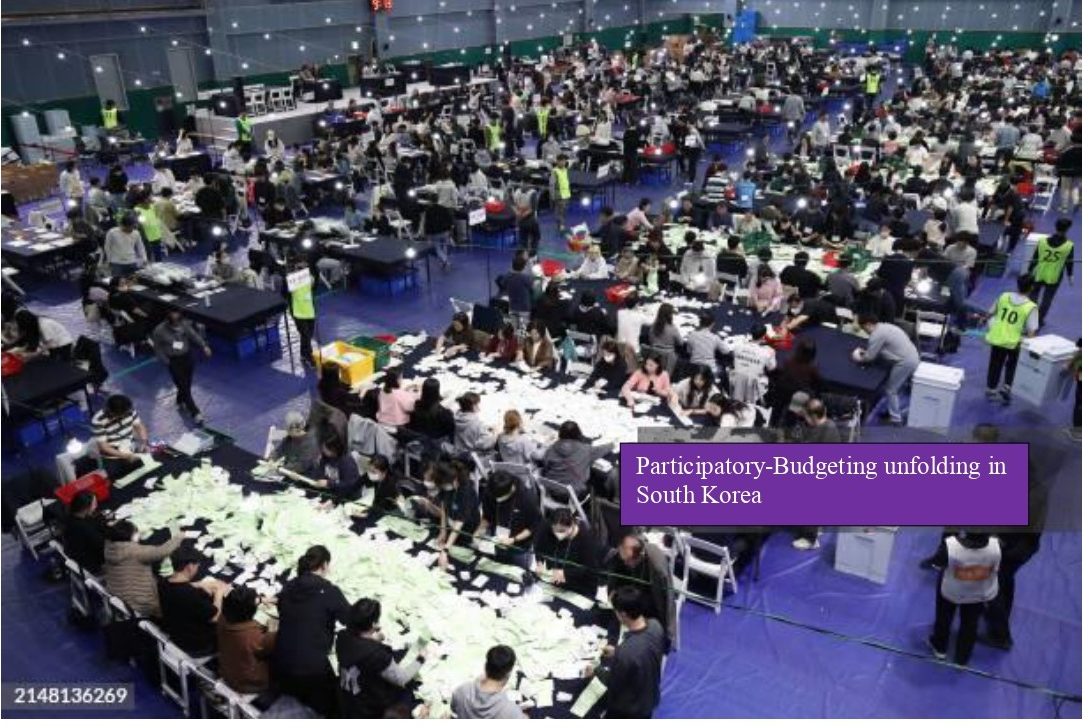
Most South Africa’s PB notion is buried in the general public participation policy framework with only minimal elucidation in Municipal Structures Act 1998, Municipal Systems Act 2000 and Municipal Finance Management Act 2003. This not only contrasts with Porto Alegre model in Brazil and United Kingdom’s PB, but also with the South Korean approach that has specific PB policy as reflected in its Participatory-Budgeting Guidelines 2003 and Standards for Participatory-Budgeting Ordinance 2006.
Lack of appropriate specific PB policy as well as PB model affects the commitment of municipalities to use appropriate procedures to engage local communities from all facets of life to participate in the participatory-budgeting processes. It also affects capabilities of municipal PBs to influence effective expenditure management and the overall municipal financial management. Lack of such specific PB policy and model creates more ambiguous policy stipulations that are easily susceptible to manipulation and application as municipalities wish. Compared with the typical Porto Alegre PB Model, this leads to situations where there are even no consequences for municipalities that flout or even bypass public participation procedures during budgeting.
Brazil’s Porto Alegre PB Model
Porto Alegre model refers to the positive outcomes of participatory-budgeting experimentation in Porto Alegre, the capital city of the State of Rio Grande do Sul in Brazil in 1989. Despite prior existence of notion of participative and deliberative democracy, Rodgers (2010:5) highlights PB experimentation in Porto Alegre to have offered insights on how participatory-budgeting can be used to engage and involve local residents to participate in different municipal budgeting activities and decisions. It emphasises that to effectively respond to the most pressing needs of local residents, such local communities must be engaged to directly participate in municipal budget deliberations and decisions (Rodgers, 2010:5).
Porto Alegre model emphasises the need for local communities’ actual participation and not just mere consultations during participatory-budgeting decision-making. Such approach contrasts the South African PB model that uses a largely consultative PB processes. Participatory-budgeting’s experimentation in Porto Alegre was motivated by workers’ party’s quests to respond to the needs of local communities by addressing the socio-economic inequities and exclusion of poor population that prevailed in the past political regimes. It also aimed to respond to political patronage practices, clientelism and corruption that existed in the pre-1988 military dictatorship (Miller, Hildreth & Stewart, 2017).
Through such experimentation, the Brazilian government sought to leverage local citizens’ democratic participation in critical municipal budgeting decisions. The motive of such approach was to reverse the spending patterns in which the spending of public resources was prioritised for just the middle and upper class neighbourhoods as the poor were excluded. Cabannes (2017:5) reveals that such initiatives were also accompanied with the quests to respond to inefficiencies and dysfunctional bureaucracy that even caused the bankruptcy of some municipalities. It was also the intention of Porto Alegre model to respond to poor municipal operations which were characterised by poor transparency of municipal transactions, inefficient management of municipal resources and low levels of citizens’ participation.
To address these constraints, Gerlit (2017:6) states that Porto Alegre model experimentation sought to increase the level of local citizens’ direct participation in critical policy decision making and to reverse the previous social spending patterns that largely favoured the affluent neighbourhoods. During such experimentation, the authorities at the city of Porto Alegre designated certain portion of the city budget for participatory-budgeting programmes.
After the designation of the budget, local residents of the city of Porto Alegre were invited and encouraged to submit different proposals on the service delivery areas that they considered as critical priorities. Thereafter, local residents were required to deliberate and vote on the project proposals that they thought were of critical priorities. Subsequently, only project proposals with the highest residents’ votes were selected and financed.
Such approach contradicts the South African PB approach exercised at the municipal level to only allow consultation and not local residents’ deliberations and making decisions on PB projects that must be financed or not financed. Yet, as Porto Alegre PB approach redirected resources to the previously neglected socio-economic service delivery areas, it delighted residents of Porto Alegre. It leveraged the level of resource redistribution and utilisation. It is from such success that Porto Alegre model was extracted and used for implementing participatory-budgeting across different Brazilian cities and municipalities.
As Porto Alegre model spread across Brazil, Rodgers (2010) states that it introduced a participatory and deliberative democracy approach through which local communities work with elected representatives and municipal officials to develop policies and budgets to respond to the most pressing socio-economic needs of the population. Porto Alegre model entails the use of four main stages that include division of the areas in the city or municipality according to specific geographical regions, information, prioritisation of the projects to be implemented and distribution of resources across priority projects.
After division of the city or municipality according to certain geographical regions, the information stage requires local residents to be notified about the participatory-budgeting programmes as well as the amount of the available allocated resources. This is followed with mobilization of local communities to come up with project proposals. Public forums constituting of local communities’ representatives, elected representatives or councillors and municipal officials vote on the projects submitted by local residents.
Subsequently, projects voted in such regions are submitted to the District Budget Forums that also constitute of local communities’ representatives, elected representatives or councillors and municipal officials to deliberate and prioritise the projects to be implemented across different regions in the district. Municipal Budget Council determines how the available financial resources must be allocated across different projects.
However, Escobar (2018:9) points out that resource distribution across different projects is based on Quality of Life Index and mobilisation and deliberation processes within the region. The implications are that poor neighbourhoods with poor socio-economic infrastructure tend to receive more budget allocation as compared to affluent neighbourhoods. Kim and Lee (2012:819) contend that throughout the year, public forums are held across different local communities in Brazil for local citizens to propose projects and make decision on how municipal resources should be allocated across such projects.
With time Porto Alegre model unfolded to require intense public participation in the key three stage of municipal expenditure management that encompass budget formulation and analysis, expenditure monitoring and tracking and municipal service delivery monitoring and evaluation. For budgeting formulation and analysis, local residents participate in the allocation of budgets according to the priorities identified by communities.
Expenditure monitoring and tracking aids local citizens’ participation in the evaluation of how the allocated budgets are being utilised across different projects. Such approach leverages local residents’ interventions to avoid resource wastage and mismanagement. During PB projects’ implementation, such activities are accompanied with local residents’ participation in service delivery monitoring and evaluation. This often entailed evaluation of not only whether PB projects are being effectively implemented, but also the quality and quantity of the services and goods resulting from such projects.
If such approach in Porto Alegre model is compared with the South African PB approach, it can be noted that there is more emphasis on South Africa’s local residents’ participation during budget formulation rather than during and after the implementation of PB projects. Following the in-depth embracement of Porto Alegre model across Brazilian cities and municipalities, Kim and Lee (2012:819) indicate that its positive socio-economic outcomes become reflected in the increment of the number of households with access to clean from 80% in 1989 to 98% in 1996.
During the same period, the percentage of the population served by municipal sewage system also increased from 46% to 85% and 200 km of road was paved in the city of Porto Alegre in just a period of eight years. With this significant progress, Guo and Neshkova (2013:331) reveal that most cities and municipalities across Brazil now have the highest ranked Human Development Index as per the United Nations’ (2004) Report on PB implementation in Brazil. Implementation of Porto Alegre model in Brazil also improved the working relationships between politicians and local communities as well as the image of the Brazilian political system.
Due to these initial positive outcomes, Porto Alegre model was adopted and embraced across different countries like South Korea, Russia, United Kingdom, Germany and South Africa among others. Yet, as different political systems or countries across the world adopt participatory-budgeting, a combination of different models have also emerged to influence how participatory-budgeting is accomplished (Karner, 2019:6).
Theories indicate that some of such critical models for participatory-budgeting that are increasingly being used by the contemporary municipalities and other government entities encompass Systematic-Cyclical PB Model. Other models include Typology of PB Decision-Making and Mathematical Models for PB Decision-Making reflecting certain Discrete and Divisible PB Models (Allegretti & Antunes, 2014:44; Boutilier, Caragiannis, Haber, Lu, Procaccia & Sheffet, 2015:190; Harkins & Escobar, 2015:5; Haris & Shah, 2020; Williams, Calabese & Harju, 2018:13). For Systematic-Cyclical PB Model, it is evident from theorists such as Harkins and Escobar (2015:5), Allegretti and Antunes (2014:44) and Buele et al. (2020:385) that similar processes are used by most municipalities. Such four stages encompass planning, design, proposal and execution.
However, Williams et al. (2018:13) caution that as such a cyclical process is being used, it is also critical to pay attention to the Typology of PB Decision-Making that often determine the effectiveness or even ineffectiveness of certain participatory-budgeting processes.
Typology of PB decision-making highlights the situation where participatory-budgeting may be considered as full or just symbolic as well as determinants of the extent to which PB is able to influence significant reallocation and redirection of public resources to where they are required most by ordinary citizens. Yet, as typology of PB decision-making is being used, theories imply it must also be accompanied with the use of certain mathematical models for evaluating PB decisions. Mathematical models for PB decision-making connote a set of theories that utilise concepts in computer science, social science, economics, mathematics and algorithms to espouse a set of the techniques for efficient and effective PB decision-making.
Mathematical modeling is divided into discrete and divisible participatory-budgeting models. This is because discrete and divisible projects raise different needs and preferences as well as implications for resource allocation and degree of completion that must be separately evaluated. Unlike discrete PB models that focus on projects that must be implemented or not implemented at all, Goel and Anilesh (2019:8) elaborate that divisible PB evaluates the degree to which a project can be completed to a certain fractional level that can be used by local communities even if it is not yet fully completed. Nonetheless, both discrete and divisible PB models aid efficient and effective PB decision-making. This bolsters the extent to which participatory-budgeting processes and outcomes are able to respond to all the dichotomous preferences of the local communities.
Some of such outcomes are often reflected in leveraging the overall effectiveness of municipal financial management. As participatory-budgeting entails the application of such mathematical models in conjunction with other PB models, it tends to induce outcomes that bolster the overall effectiveness of municipal financial management. Municipal financial management requires municipal officials to develop the budget plan as well as a framework reflecting critical expenditure management strategies for its implementation.
Even if these have always been major challenges of most municipal authorities to thereby cause resource misallocation, recent introduction of participatory-budgeting has significantly improved how municipal financial resources are managed (Vagin, Gavrilova & Shapovalova, 2015b:117). Participatory-budgeting leverages municipal financial optimisation, expenditure management as well as improved level of accountability that minimises wastes, financial mismanagement and corruption. These further spur not only the level of municipal finance optimisation, but also the overall effective municipal financial management. In turn, these catalyse improvement in service delivery to leverage the level of local residents’ trust and confidence in municipalities (Sergienko, 2015:210; Vagin, Gavrilova & Shapovalova, 2015a:19).
However, the extent to which PB is able to influence the achievement of such enormous positive outcomes is often still determined by how a combination of certain critical success factors are integrated during the implementation of participatory-budgeting. Such critical success factors encompass political system, citizens’ engagement, citizens’ participation, collaborative governance and PB projects’ monitoring and evaluation (Song, 2013:221; Sintomer, Traub-Merz, Zhang & Herzberg, 2013:9; Thomas, 2013:786; Wampler & Hartz-Karp, 2012:62). The integration of all such critical success factors in PB implementation edifies the ability of participatory-budgeting to produce outcomes that spawn not only effective municipal financial management, but also improved service delivery. However, unlike the Brazilian and South Korean PB systems, South is yet to develop a clear participatory-budgeting policy.
Participatory-Budgeting In South African Municipalities
South Africa does not have specific policy and law or even a model on participatory-budgeting. However, ideas of participatory-budgeting approaches used in most of its municipalities are derived from the broader principles of public participation. Such principles emphasise the need for wider participation of local communities in different municipal activities (Kusambiza-Kiingi, 2019:5; Bassett, 2016:2; Buccus, 2018:11). Perhaps it is such stronger emphasis of wider public participation that may be explains the reason why South Africa has not yet adopted specific policy and law on participatory-budgeting. Attributable to that is the presumption that such wider public participation laws and policies would also influence the wider participation of local communities in municipal budgeting activities. Unfortunately, facts so far indicate that has often not been the case due to lack of specific PB guidelines reflecting how municipalities must accomplish PB activities (Bassett, 2016:2; Buccus, 2018:11). This contrasts with the case of South Korea, United Kingdom and Brazil that have specific participatory-budgeting guidelines that guide how PB activities are accomplished at the local government level (Cabannes & Lipietz, 2015:6; Jung, 2014:9; Kim, 2010:801; Samuel, 2020:4).
Most public participation principles from which South Africa’s concept of participatory-budgeting is extracted are reflected in a combination of different laws and policies on public participation in different municipal activities in South Africa. One of such laws is the 1996 Constitution of the Republic of South Africa. Promulgation of the 1996 Constitution significantly changed and transformed how budgeting was hitherto accomplished in South Africa. Prior to 1996 Constitution, South Africa used central budget allocation system to have budget allocation across national and provincial departments as well as different sectors solely determined by a central committee.
However, after the introduction of the 1996 Constitution, such approach was changed to have budgets allocated to national, provincial and local government spheres that in turn have powers and authority to determine how such budgets must be allocated across different sectors and activities in their jurisdictions (Bassett, 2016:2). Through the decentralisation of budgeting authorities and powers, Section 152 of the 1996 Constitution indicates that the Constitution aims to ensure that government offers democratic and accountable local government to local communities.
It also seeks to leverage sustainable socio-economic development, provision of critical socio-economic services and integrate local communities and their associated organisations in all matters of local governance. To further encourage local communities’ participation in all government activities, Section 118(1) of the 1996 Constitution requires provincial legislatures to allow public access into the legislatures and to engage and involve them in different legislative deliberations (Makwela, 2012:5).
It stresses the need for the legislatures to not only create the mechanisms for such public engagement and involvement, but also ensure that legislative activities are accomplished in more transparent way. In enhancing transparency of the legislative processes, Section 118(1) highlights that the public may only be prevented from accessing legislatures in situations that can only be deemed fit on certain reasonable grounds. Sections 118(1) and 152(1) emphasises the need for local government to facilitate the involvement and engagement of local communities and organisations in the accomplishment of different local government activities. However, Makwela (2012:5) notes that Section 152(1) does not just require local communities to be merely consulted.
Instead, she states that the provision requires local communities to be consulted and directly involved in different policy deliberations at the local government level. Even if that is the case, lack of specific PB guidelines still affects how such Constitutional principles can be translated to edify effectiveness of participatory-budgeting at the municipal level. Such broad and ambiguous Constitutional principles on public participation are further reflected in the 1997 White Paper on Transforming Public Service Delivery that elucidates on the critical Batho Pele principles for leveraging public participation in local government activities. Batho Pele which is a Sesotho phrase meaning “people first” outlines principles that require government to place people at the centre of service delivery initiatives. This enhances capabilities of the South African public service system to plan in collaboration with local communities and provide services that meet the needs and demands of the local population.
To achieve that, Batho Pele enunciates consultation, service level standards, courtesy, access, information, openness and transparency, redress and value for money as critical principles that must be integrated in governmental operations and service delivery processes (Department of Public Service and Administration, 1997 as cited in Department of Public Service and Administration, 2019:13). However, just like the 1996 Constitution, Batho Pele principles also just create favourable conditions for the implementation of participatory-budgeting without dealing specifically with how local communities can participate in municipal budgeting.
To enhance service delivery, Batho Pele Principles outline eight main principles that include consultation, service standards, courtesy, access, information, openness and transparency, dealing with complaints and giving best value. Consultation calls for the consultation and involvement of citizens in all matters that concern the provision of services to the population. It is often aimed at eliciting the views of citizens about services being provided. This creates avenue for the improvement of the ways services are offered to the citizens (Department of Public Service and Administration, 2019:13).
Even if that implies such activities also include the need for the involvement of local population, most municipal authorities often involve local residents in other service delivery activities, but not budgeting. Batho Pele principles require consultation to be accompanied with the need to set the appropriate service level standards. Setting the appropriate service level standards enhances the improvement of the quality and quantity of the services offered to the population. Courtesy emphasises the need for public officials to feel and empathize with local citizens during the process for the delivery of different services. It is also aimed at improving the quality of the offered services. Courtesy goes hand in hand with the need to improve access to different services (Department of Public Service and Administration, 2017:1).
Access stresses the importance of ensuring all citizens are able to access all services that they require with relative ease. Access to different services must be accompanied with the improved citizens’ access to information. Access to information renders it possible for citizens to evaluate the quality of the offered services and to provide insights on the improvement initiatives that may be required (Christensen & Laegreid, 2016:16). This improves openness and transparency that require public servants to allow access by citizens to all the decision making processes (Chipkin, 2012:5). Though that would allow local residents to access key budget decision-making processes, Batho Pele still only emphasises the need for local residents to access, but not participate and deliberate to make decisions that meet their needs and preferences.
Other limitation of Batho Pele as a prerequisite for enhancing PB effectiveness is that it emphasises the need for public officials to report to citizens about decisions that have been undertaken on the programmes and services that must be provided (Christensen & Laegreid, 2016:16). Reports on decisions that have already been concluded do not offer any good basis for PB implementation that often requires the integration of local residents at the commencement of its conceptualisation. Redress as the other key Batho Pele principle seeks to ensure that deviations are assessed, identified and corrected to improve the overall effectiveness of service delivery processes. This must be accompanied by the initiatives of ensuring that the government department produces value for money (Christopher & Hossain, 2013:33).
Value for money as one of the principles of Batho Pele requires the development of appropriate control systems to minimise wastes (Chaston, 2011:9). despite its inherent limitations, the 1997 Batho Pele principles still catalysed the wider embracement of the notion of public participation to create conducive conditions for municipalities to use the contemporary South Africa’s notion of participatory-budgeting. However, quests and commitments to practically implement the Constitutional principles of public participation at the local government level are not only reflected in the 1997 Batho Pele principles, but also in the promulgation of the 1998 “White Paper on Local Government” (Department of Local Government. 1998 as cited in Kusambiza-Kiingi, 2019:5).
Just like the 1996 Constitution, Kusambiza-Kiingi (2019) explains that the 1998 White Paper agitated for a developmental local governance system in which public officials interact and require local citizens to participate in the accomplishment of different local government activities. It posits that a developmental local government is a governance approach in which public officials exhibit commitment to collaboratively work with local communities to develop amicable and sustainable solutions to local residents’ socio-economic needs and preferences. It stresses importance of collaboration of local government officials with local communities to develop and implement relevant service delivery policies that would ameliorate local residents’ poor socio-economic living conditions.
As cited in Kusambiza-Kiingi (2019:5), the 1998 White Paper stresses the need for strengthening municipal-local residents’ relationships by requiring local residents to work closely with municipal councils. It states that municipalities must develop systems for local communities as voters and end-users to be engaged to get involved and participate in different municipal activities. In otherwords, the 1998 White Paper stresses that municipalities must ensure active participation of local communities at four levels as voters, citizens, consumers and end-users and partners.
As voters, local communities are required to ensure optimum democratic accountability of the elected local political leadership for the policies they are empowered to promote and implement (Ngidi & Dorasamy, 2013:13). As citizens, local communities must express their views through different stakeholder associations before, during and after policy development to ensure such policies reflect local community preferences in all aspects. As consumers and end-users, local communities must be offered value-for-money, affordable services and courteous and responsive services. Regarding partners, local communities must be considered as critical collaborators with the municipalities in the development and implementation of different local government policies (Ngidi & Dorasamy, 2013:13). All these four levels of local communities’ participation in municipal affairs offer favourable ground for successful implementation of participatory-budgeting.
However, it is the second level of local communities as citizens that directly link with critical PB activities that require local residents to be involved before, during and after PB implementation. Yet, as policies are being implemented, the 1998 White Paper also stresses the need for local communities to participate in monitoring and evaluation. Unfortunately, Ngidi and Dorasamy (2013:13) highlight that in most cases, most municipalities have often just bothered to involve local residents in budgeting decisions, but not in the monitoring and evaluation of its processes of implementation. This limits the capabilities of different PB projects to achieve the desired outcomes.
Despite that, public participation principles articulated in the 1996 Constitution, 1997 Batho Pele principles and the 1998 White Paper on Local Government influenced the integration of public participation as well as approaches analogous to participatory-budgeting in some of the legislations used at the municipal level. Such legislations encompass Municipal Structures Act 1998, Municipal Systems Act 2000 and Municipal Finance Management Act 2003. For Municipal Structures Act 1998, Sections 72-78 emphasise the need for creation of operational ward committee systems to link local communities with municipal councils (Pillay, 2014;5).
Besides acting as a formal communication channel between local communities and council, Sections 72-78 also state that ward committee may also make recommendations on issues affecting the ward to the ward councillor or directly through ward councillor to municipal council. Municipal Structures Act 1998 states that ward committees that are elected by local communities that they serve should not have more than ten members (Pillay, 2014:5). Though ward councillor representing a particular ward in municipal council is required to be the ward chairperson, Sections 72-78 further emphasise the need for equity in the representatives of local communities at the ward committee. It requires women as well as other people from diverse interests such as disablesd to be equitably represented in such ward committees.
However, it is evident that although Municipal Structures Act 1998 emphasises the need for local communities’ participation in municipal activities, it still highlights that the final decision rests with the council. To a large extent, Vusi (2017:5) notes that such a provision implies local communities’ participation is purely consultative to induce information from the communities that aid council deliberations and decisions. Such consultative approach may nonetheless not be suitable for aiding effectiveness of PB processes that often require deliberating and making decisions that council just adopts and funds.
To leverage local communities’ participation in municipal affairs, Section 16(1) in Chapter Four of the Municipal Systems Act 2000 stresses that municipalities must develop and entrench a municipal governance culture in which representative governance is complemented with a system of participatory governance. During such quests, Chapter Four of the Act requires municipality to foster local communities’ participation in Integrated Development Planning (IDP), budgeting, key strategic service delivery decisions and performance management.
For local communities to effectively participate in such activities, it also requires municipalities to develop and use effective mechanisms, processes and procedures that reflect the approaches for receiving and responding to public petitions and complaints. It must also establish processes for informing and allowing local communities to comment about essential decisions in areas like by-laws, IDP, budgeting and service delivery strategies.
Even if Municipal Systems Act 2000 specifically emphasises local communities’ participation in budgeting, lack of clear accompanying guidelines on how it can be used for PB processes still undermines its effectiveness as the law prescribing and emphasising the need for PB. At the same time, it also only requires local communities’ consultation and not active participation in deliberation and decision making as it is often the case with an effective participatory-budgeting process. For Municipal Finance Management Act (MFMA) 2003, Khuzwayo (2009:12) highlights that MFMA also points out the need for local communities’ participation. MFMA reiterates that public participation can be enhanced by requiring municipal accounting officer to immediately inform the public after the annual budget is tabled before the municipal council.
Such notification must integrate all the substantiating documents and request local communities to comment on budget provisions. Even though it is obligatory for council to consider local residents’ views about the budget, council is still required to offer mayor the chance to respond to such submissions. In certain cases, the mayor may order for budget revisions so that the amendments can be tabled before council for considerations.
Despite such a process offering the opportunities for local residents to comment on the budget, such opportunities only tend to arise after the budget has already been decided and tabled before council. Thus, it contributes only quite minimally to enhancing the integration of local residents’ inputs into final budget decisions.
Yet, as Planact (2016:16) indicates, MFMA also emphasises that in situations where the municipality aims to strike a contract with significant future budgetary implications, drafts of such contracts must be availed to local communities for their views and comments. Thereafter, municipal council is expected to take such comments in account when deliberating over such contracts. Besides stating that Service Delivery and Budget Implementation Plan (SDBIP) should be approved within 28 days after budget approval, MFMA also requires all annual reports about the implementation of such service delivery activities to be tabled before council and made public.
Thereafter, a reasonable time must be allocated for deliberations on the comments from local communities and for any member of the local communities to address council. Even if all these processes allow local communities to participate in municipal budgeting processes, International Budget Partnership (2013:7) still points out that the processes prescribed in MFMA still fall short of the critical participatory-budgeting processes.
Nevertheless, it is still evident from these policy and legal frameworks that the contemporary South Africa’s notion of participatory-budgeting is extracted. Yet, as the South African government further sought to entrench public participation in different local government activities, it introduced the National Policy Framework for Public Participation (NPFPB) in 2007 (Department of Local Government, 2007 as cited in Vusi, 2017:5). National Policy Framework for Public Participation (2007) construes public participation to connote an open and accountable process through which individuals and groups in selected communities are able to exchange views and influence government decisions.
To accomplish that, it outlines critical principles that stress that public participation must seek to promote the values of good governance and human rights as a fundamental rights of all citizens to participate governance systems. It also states that public participation must aim to reduce social distance between the electorates and the elected institutions. It must recognise the intrinsic values of all people from local communities that are involved in the accomplishment of different local government activities.
As cited in Vusi (2017:5), National Policy Framework for Public Participation (2007) also requires citizens to participate in different government activities as individuals, interest groups or as local residents. Finally, it also emphasises the need for the utilisation of ward committees as mechanisms for linking local communities with the elected institutions. In addition to requiring such in-depth level of public participation, National Policy Framework for Public Participation (2007) also highlights that local communities must be engaged to participate in municipal budgeting processes as well as the development of IDP, performance management systems and other service delivery activities.
To ensure effective public participation and response to citizens’ needs, it requires government to use Citizens’ Participation Charter, Community Complaints Management System and frequent Citizens’ Satisfaction Surveys. However, it is still evident that despite emphasising citizens’ participation in municipal budgeting, the National Policy Framework for Public Participation (2007) just like other policies and laws does not also specifically deal with how participatory-budgeting can be accomplished.
But even in the midst of using a general policy on public participation without specific PB policies and laws, it is still evident that such general mechanisms of public participation are still reminiscent of the approaches that can easily be replicated to enhance effectiveness of participatory-budgeting in South Africa’s municipalities. Buccus (2018) and Department of Local Government (2012) highlight some of the mechanisms for public participation in South Africa that are also used in participatory-budgeting to encompass public hearings, public access to portfolio committee meetings, outreach programmes and information dissemination, petitions, Izimbizo and Green/white Paper Processes.
Other mechanisms include local residents’ participation in Integrated Development Planning and Service Delivery and Budget Implementation Plan, the use of ward committees, public meetings, public hearings, consultative sessions, report-back meetings, advisory committees, focus or interest group discussions, petitions and questions to council. But even as different municipalities use such general mechanisms of public participation to accomplish participatory-budgeting, Girma (2012:5) Kusambiza-Kiingi (2019:5), Bassett (2016:2) and Buccus (2018:11) still share similar views that the overall effectiveness of participatory-budgeting in most of South Africa’s municipalities is still marred by a combination of different constraints.
Constraints of Municipal PBs in South Africa
Most participatory-budgeting processes in most South Africa’s municipalities are reiterated by Bassett (2016:2) to be constrained by poor participation of local communities. Even in the midst of notifying local residents about different participatory-budgeting programmes, the response from the communities have often been quite slow. Most local residents have lost faith, trust and confidence in participatory-budgeting processes that often do not lead to the outcomes that respond to their needs and preferences.
Bassett (2016:2) attributes this to the fact that most participatory-budgeting processes are mainly consultative and therefore do not permit local residents to express their views by directly deliberating and voting on the service delivery projects that meet their dichotomous needs and preferences. Such a challenge also undermines local residents’ capabilities to dictate how municipal financial resources must be utilised to thereby induce situations that affect effective municipal financial management.
As required by legislations like Municipal Structures Act 1998 and Municipal Systems Act 2000, local South African communities can attend council meetings, but cannot vote to influence council decisions on the service delivery projects that they need. Such approach is not typical of the Porto Alegre PB model as well as the South Korean PB model where local residents’ needs and preferences expressed through local residents’ voting decisions are adopted, funded and implemented by local authorities (Bartels, 2014:656; Jung, 2014:241; Sigerson & Gruer, 2011:5). South Africa’s PB approach also contradicts the United Kingdom PB community grants and “top-slicing” models where local residents’ decision through voting the priority projects that must be funded is final and must be adopted by local councils (Harkins & Craig, 2010:12; Osborn, 2011:3).
The rather more consultative South Africa’s PB is also not consonant with the Kenyan PB approach where Nyakarura, Ireri and Lyria (2016:525) highlight that priorities identified from all the eight constituencies are combined and harmonised during a citywide consultative forum constituting of three local communities’ appointed representatives from each ward, ward councillors and city officials. It is the consensus or decisions reached during such citywide consultative forums that are prioritised as critical service delivery projects and programmes that must be financed by city authority. Even though such Kenyan PB model is typical of the PB model used at the City of Johannesburg, a challenge still arises from the fact that due lack of specific PB guidelines, replication of such more plausible PB model across all South Africa’s municipalities seems to yet be a challenge.
Instead, South Africa’s more consultative PB processes seem to tally well with the more consultative PB approach used in Germany. German PB model allows citizens to participate in budgeting, but not to make decisions on the projects that can be or cannot be funded and implemented. Yet, as the German government adopts such consultative PB approach, Jelizaveta and Ringa (2013:18) reveal that it has often discouraged the wider participation of local Germans in participatory-budgeting processes.
Just like in South Africa, such poor citizens’ participation renders German participatory-budgeting processes less effective (Gumicio-Dagron, 2010:3; Junge, 2012:9; O’Leary, Van Slyke & Kim, 2010:6). It is not therefore questionable that despite the use of participatory-budgeting, most local residents still complain and protest about service delivery failures in most South Africa’s municipalities. Yet, besides that even if PB consultations are undertaken by some of the municipalities, Buccus (2018:11) highlights that some of the municipalities just tend to do that as formalities without real commitment to integrate outcomes of such consultations into budgeting decisions.
Buccus (2018:11) reveals that failure to integrate local residents’ needs and preferences in PB decisions is further compounded by the tendencies of most municipalities to only consult local residents after budgeting decisions and other policy decisions have already been made. Unless inputs from local communities indicate issues which are of serious local residents’ concerns, endeavours are often not undertaken by the mayor and council to integrate such inputs into budget decisions.
Such a view echoes Okeke-Uzodike and Dlamini’s (2019:458) revelations that most challenges of participatory-budgeting across South Africa’s municipalities arise from poor communication strategies and inadequate information sharing as well as poor political mobilisation. Other challenges arise from limited involvement of local communities, inadequate budgeting skills, limited knowledge about participatory-budgeting and inability of local politicians to separate politics from PB development activities.
Most PBs in South Africa’s municipalities are also constrained by poor timing of participatory-budgeting, lack of durable partnership between civil society organisations and council and monopolization of budget information and work by a few people. As Kusambiza-Kiingi (2019:5) notes, such exclusion of a huge segment of local population would affect the quality of policy inputs as well as their buy-in and legitimacy of certain policy decisions. Such a view substantiates Buccus and Hicks’ (2010:9) reasoning that policy-making arena characterises contestations that influence emergence of policy as a result of conflicts, negotiations, bargaining and compromises between different groups.
However, in such contestations, Buccus and Hicks (2010) highlight that politicians rather than local communities tend to have a dominant power with the effect that they tend to determine what is or is not included in policy agenda. This not only affects integration of local communities’ interests in policy decisions, but also explains why when it comes to implementation of different PB policies, power tends to devolve to government agencies rather than local residents.
Buccus and Hicks (2010:9) elaborate that it often emerged that as local communities express their interests and politicians deliberate over different policies, it is the bureaucrats that dictate the terms and conditions for the implementation of such policies. While also acting with national actors that often have dominance over municipal political and administrative actors, Buccus and Hicks (2010:9) note such situations to often cause bureaucrats to sort out certain policies that must be implemented to leave out others that may nevertheless still be critical for meeting local population’s needs and preferences. In otherwords, constraints are not only reflected in PB approaches used in South Africa’s municipalities, but also in the suggestions and propositions of different studies on PB in South Africa that do not offer any plausible PB model that can be replicated.
To address PB limitations in South African municipalities, different studies conducted by Okeke-Uzodike and Dlamini (2019:458), Motale (2012:49), Matena (2018:122), Langa and Jerome (2004:99) and Leduka (2009:109) suggest different discrete measures for leveraging effectiveness of participatory-budgeting across South Africa’s municipalities. However, none has so far emerged with a more plausible model reflecting policy guidelines, critical PB processes and key success factors that must be replicated in PB implementation in South Africa. It is such PB deficiencies that this research seeks to address. Nonetheless, in such proposals, Okeke-Uzodike and Dlamini (2019:458) suggest the need for municipal participatory-budgeting to integrate all local residents from all facets of the local communities. They reason that such broader participation would enhance capabilities of PB processes to respond to all the dichotomous needs of the local population.
However, such suggestion seems to be only a key success factor rather than the critical deliberative process for leveraging effectiveness of municipal participatory-budgeting. Such views are also echoed in Motale’s (2012:49) suggestion that there is need for the review of the existing municipal PB processes to encourage full participation of local communities. He also suggests that this must be accompanied with the use of effective two-way communication to aid dissemination of information to local residents and feedback from local residents to municipal authorities on how PB processes can be improved.
Motale (2012:49) also proposes that municipal staff and local residents must be trained, developed and empowered on the critical technicalities for accomplishing PB activities. He emphasises the need for consultation and involvement of local communities in PB deliberations and decision-making. Though such a suggestion seems plausible, it is less effective since without a clear PB model as it is argued in this research, it is still difficult to define the points at which local communities can be involved as well as the critical rules that would guide such deliberations. Motale (2012:49) further suggests the need for benchmarking PB activities across municipalities, but without a clear PB guideline reflecting points of best practices that such benchmarking must be based, such benchmarking may not induce the desired outcomes.
As depicted in the insights in the video below, there is lack of a uniform PB model that can be replicated by all the South African municipalities. Such evidence of lack of a PB model suggestion is not only reflected in Motale’s (2012:49) suggestions, but also in Leduka’s (2009:144) proposition. In that proposition, Leduka (2009:144) argues that creating favourable political and cultural environment is critical for facilitating effective accomplishment of participatory-budgeting activities as well as the need for municipalities to ensure that citizens’ inputs are integrated in budgeting decisions. Langa and Jerome (2004:99) suggest the need for improving municipal budgeting transparency and increased local citizens’ participation in such municipal budgeting processes to leverage effective response to citizens’ service delivery needs.
Just like Leduka’s (2009) proposition, Langa and Jerome’s (2004:99) suggestions also seem to highlight only the key success factors for PB implementation rather than a model that can be replicated for PB implementation across all South Africa’s municipalities. Such limitations are also reflected in Matena’s (2018:123) proposition that to leverage municipal PB’s effectiveness, the process must integrate government priorities and citizens’ needs, educate local communities about their roles in budgeting and integrate local communities at the drafting phase of budget development. He also emphasises the need for feedback to local residents about PB implementation progress and stronger community participation in monitoring and evaluation of the process for utilising and spending PB funds. In otherwords, all these suggestions and propositions offer critical insights on how PB can be implemented.
However, such suggestions and propositions only tend to reflect critical success factors rather than a comprehensive PB model that can be replicated across all South Africa’s municipalities. Combined with PB policy and laws that only offer ambiguous PB approach, it is not surprising that all these challenges are marring effectiveness of most South African municipalities’ PB processes. In effect, it is suggested in the managerial implications that to improve the involvement of ordinary citizens in public budgeting, it is essential to adopt a PB framework modeled along Porto Alegre Model as well as the South Korean and United Kingdom PB models.
Managerial Implications
It is argued that successful implementation of PB programmes in South African municipalities would require the use of specific policy and model on participatory-budgeting. However, as much as such a thinking is derived from the ideologies in Porto Alegre model as well as the UK and South Korean PB models, it still reflects the modifications of such models. This is because Porto Alegre, UK and South Korean PB models do not reflect the critical success factors for PB implementation.
Thus, it is argued in the participatory-budgeting model for effective financial management that the use of such a model will not only induce improved municipal expenditure management, but also improved municipal financial management and service delivery. However, to achieve such positive outcomes, the South African government must develop and use effective National/Central Government PB Framework and Municipal PB Framework.
Such frameworks must be implemented in consideration of certain key success factors for PB implementation. To respond to the existing lack of specific PB policy in South Africa, it is argued that the National/Central Government PB Framework must reflect specific Municipal Participatory-Budgeting Policy Guideline. This will introduce more clarity on how PB activities are accomplished at the municipal level. Such national PB policy must also introduce provisions that designate a certain percentage of the national budget which is allocated to participatory-budgeting at the local government level.
Subsequently, the central government must distribute to the districts the percentage of the national budget allocated for participatory-budgeting to municipalities. This will not only cure the challenge of financial shortage for PB activities at the municipal level, but also demonstrate the extent to which the central government is committed to use PB programmes to respond to the most pressing socio-economic needs and preferences of local South Africans across the country.
Yet, as the National/Central Government PB Framework is being conceptualised and introduced, the South African government must also introduce the Municipal PB Framework. Such Municipal PB Framework must seek to address the current consultative municipal PB challenges by requiring local residents to deliberate and vote in key PB programmes’ decisions. To accomplish this, it is emphasised that the Municipal PB Framework must use certain nine steps that encompass:
- Designation of municipal PB funds
- Establishment of Municipal Participatory-Budgeting Committee
- Community proposals’ soliciting
- Proposals’ review
- Local Residents’ voting
- Adoption of local residents voting decisions
- Funding
- Implementation
- PB projects’ monitoring and evaluation
Regarding designation of municipal PB funds, municipal authorities must designate 10% of the locally generated revenues for PB programmes and combine it with the total amount received from the National/Central Government PB Fund. With municipal PB funds designated, municipal authorities must establish the Municipal Participatory-Budgeting Committee that constitutes of representatives of local residents per ward, ward councillors and municipal administrative officials to manage municipal participatory-budgeting activities. It is that Municipal Participatory-Budgeting Committee that must take the initiatives to inform local communities through all the available channels about the available PB programmes and invite them to submit proposals for projects that would address the major service delivery concerns in their areas.
Once local communities have submitted proposals on projects and programmes that are of major concerns in their areas, Municipal Participatory-Budgeting Committee must review the submitted project proposals to discern whether they fall within the designated PB programmes. Subsequently, the selected project proposals that are within the designated PB programmes must be subjected to direct voting by local residents in the areas where the project is proposed to be implemented.
Outcomes of voting process reflecting the PB projects voted by the majority of local residents must be adopted by municipal council without questioning the choice of the majority of local residents that voted on the projects that must be implemented in their areas. Municipal council’s approval of such PB projects must be followed by funding and implementation where Municipal Participatory-Budgeting Committee sit again to assess how the available municipal PB funds must be allocated across different projects that were voted by local residents.
Yet, as such PB projects are being implemented; local communities must be involved and engaged to participate in the evaluation of how different PB projects are being implemented. Local residents must also assess whether the allocated resources are being used according to budget plan. They must also identify and mitigate areas of wastes like corruption, financial mismanagement and irregular, fruitless, wasteful and unauthorised expenditure in the implementation of PB programmes. It is through such processes that municipal PB framework will induce effective municipal financial management to catalyse successful service delivery. However, to realise such positive outcomes, implementation of national as well municipal PB frameworks must be accompanied with the integration of certain critical success factors for PB implementation. Such key success factors that encompass:
- Enforcement and sanctions for non-compliance with PB policy
- Political system emphasizing deliberative and participatory democracy
- Citizens’ engagement
- Citizens’ participation
- Collaborative governance
- PB projects’ monitoring and evaluation
Whereas political system emphasizing deliberative and participatory democracy may not be a challenge in South Africa given its wider democratisation and liberalization, PB challenges are still often reflected in poor enforcement and sanctions for non-compliance with PB policy, citizens’ engagement, citizens’ participation, collaborative governance and PB projects’ monitoring and evaluation. In effect, future studies must consider exploring the critical determinants for successful PB utilisation in South African municipalities.
Cite: Mhlanga, N.S., & Okanga, B. (2025). Brazil’s Porto Alegre PB Model: Contrasted with South Africa’s PB Approach. London: Elicitor.