By
Meher Pratik Malvania
Berlin, Germany
Abstract
As the additive manufacturing technologies continue to evolve and improve, their further integration into mechanical engineering has also continued to improve. In effect, the thin line between mechanical engineering and additive manufacturing is increasingly becoming blurred as additive manufacturing gets to be regarded as the best-known aspect of mechanical engineering. This is because of the cost, efficiency, quality and waste minimization values that additive manufacturing has introduced into mechanical engineering. Compared to the traditional manufacturing approaches, additive manufacturing is the systematic process of using accurate steps that keep on adding one material and layer after another until the final product is developed. This reduces wastes. It reduces costs, while also improving the efficiency of mechanical engineering. It is such values of additive manufacturing that have redefined the nature of mechanical engineering as compared to the traditional manufacturing approaches. Reduced wastes eliminate costs to in turn bolster the mechanical engineering business’ improved cost competitiveness. Additive manufacturing is not only the future of mechanical engineering, but also business sustainability. It bolsters cost minimization, while also improving quality management. However, additive manufacturing is still affected by technical limitations like build volume restrictions, surface finishing, post-processing limitations and batch-to-batch material property variations. Besides quality control issues, additive manufacturing is also often affected by the hefty initial investment and maintenance costs and software incompatibility issues. Further research ameliorating these deficiencies is therefore essential for improving the efficacy of additive manufacturing to continue driving mechanical engineering’s change and transformation.
Keywords: Additive Manufacturing; Mechanical Engineering; Manufacturing Operations
INTRODUCTION
Increasing cost and waste minimization quests aimed at leveraging cost competitiveness are driving most of the contemporary mechanical engineering firms to adopt additive manufacturing as the way forward (Waddington, 2026). In that process, additive manufacturing has introduced new technologies that are increasingly changing and transforming the overall nature of the approaches used in mechanical engineering. As the way forward into the increasingly more competitive manufacturing business world, additive manufacturing is emerging as a critical driver of a firm’s cost competitiveness. Additive manufacturing is the manufacturing approach that uses a layer-by-layer approach to new product development. After creating a 3D design using computer-aided design and computer-aided engineering, the product designs are constructed layer by layer until all the components are created and sent directly for 3D printing (Goh et al., 2024). Additive manufacturing leverages waste minimization. Tendencies of additive manufacturing enterprises to create the initial product design against which the later designs and materials are added often reduce wastes and costs. It enables the mechanical engineers order and use only the required material quantities. For years, the traditional manufacturing methods focused on identifying, cutting and reducing wastes until the final products were created.
In contrast, additive manufacturing uses accurate steps that keep on adding one material and layer after another until the final product is developed (Ciccone et al., 2023). Additive manufacturing uses a logical process of creating a model within the defined parameters, running simulations to account for anisotropic properties, converting designs into printable STL, AMF and 3MF formats, slicing parameters to define mechanical properties, and managing digital inventory for on-demand production. This reduces wastes. It reduces costs, while also improving the efficiency of mechanical engineering. It is such values of additive manufacturing that have redefined the nature of mechanical engineering as compared to the traditional manufacturing approaches (Ma et al., 2023). Reduced wastes eliminate costs to in turn bolster the mechanical engineering business’ improved cost competitiveness. Additive manufacturing is not only the future of mechanical engineering, but also business sustainability. It not only aids cost minimization, but also improved quality management.
The traditional manufacturing approaches often use molding tools to frame and continue cutting the product until the desired final product is created. That is not the case for additive manufacturing that uses a more careful one-after-another process of new product development (Ben Said et al., 2025). This step-by-step process permits meditation and pre-meditation to ensure that each of the steps undertaken towards building and developing the product meets not only the design requirements, but also the designated quality specifications. This improves quality evaluation and management. It also improves quality control to ensure that the final product is created in the way that meets quality specifications, while also surpassing the often-sophisticated cosmetic needs and demands of the contemporary consumers. It is such unique values that are increasingly driving additive manufacturing’s capabilities to change and transform the overall nature of the approaches used in mechanical engineering.
Additive Manufacturing
As additive manufacturing technology continues to advance and improve, it is not only changing and revolutionizing the nature of mechanical engineering, but also civil and biomedical engineering. Additive manufacturing has now evolved to be known as 3D Printing. However, Horner (2025) notes the concept of additive manufacturing to have first emerged in the 1980s when the industrialists invented it for usage in prototyping. The first concept of additive manufacturing emerged from stereolithography, which was first used by Charles Hull in 1983. Using stereolithography, ultraviolet light was used to harden layers of resin until objects were formed. As the industrial engineers grappled with how to design and build very tiny complex parts, the concept of additive manufacturing was adopted in the development of the required prototypes. Using these prototypes, additional layers and parts would be gradually added until the total complex product was developed (Waddington, 2026). Though this contrasted with the traditional manufacturing approaches that used just molds, the concept of additive manufacturing was still not widely used. This is because it was quite expensive and complex. Therefore, unless the product to be designed was very intricately complex, industrial engineers were very reluctant to use additive manufacturing (Horner, 2025).
However, continuous improvement of additive manufacturing technology influenced its increasing adoption in more complex mechanical engineering activities. This influenced the embrace of additive manufacturing’s usage in the more complex sectors like aerospace and automobile engineering. Increasing adoption of additive manufacturing influenced its continuous improvement and adoption in different complex mechanical engineering operations. Combined with its increasing integration with computer usage to influence the emergence of concepts like 3D Printing, additive manufacturing technology came to be adopted and used across different mechanical engineering operations (Horner, 2025). It transformed the cost-effectiveness and efficiency of engineering design, prototyping and manufacturing. Because of the layer-by-layer approach introduced into mechanical engineering, additive manufacturing technology introduced the greatest level of flexibility, design freedom and efficiency. This rendered the previously complex and undoable engineering tasks easier and more efficient to do.
From this activity, new thinking and practices emerged in the concept of additive manufacturing to redefine how mechanical engineers developed designs and prototypes as part of different products’ development processes (Dubey et al., 2024). Besides design flexibility, additive manufacturing was and is still being widely adopted by mechanical engineers due to its capabilities to enhance mass customization, improve prototyping speed and customization. Mechanical engineers continue to adopt the use of additive manufacturing in all areas that involve the manufacturing of tiny, complex and lightweight products. In aviation engineering, mechanical engineers have adopted the use of additive manufacturing during fuel nozzle manufacturing. Compared to the traditional manufacturing technology, this has influenced the development of fuel nozzles that improve efficient fuel flows, while also saving fuel and reducing the disruptive emissions into the global ecological environment (Arefin et al., 2025).
Ford and BMW have also adopted the use of additive manufacturing in the development of more efficient, lightweight and custom components for all their high-performing vehicles. In mechanical engineering, Moorthy (2024) further notes that the adoption of additive manufacturing has increased the diversification of the kinds of printable materials used in mechanical engineering. In the past, traditional manufacturing processes, the additive manufacturing technology was mainly used for plastics and polymers. However, following the previous inventions leading even to the introduction of 3D Printing, the range of printable materials has increased from just polymers and plastics to encompass ceramics, metals, biomaterials and composites. Additive manufacturing technology has further improved to encompass even the use of technologies like electron beam melting and selective laser melting to produce highly complex metal parts with precision and strength. Additive manufacturing has been widely adopted by mechanical engineering in industries like aerospace, medical device making and automotive engineering that use a lot of lightweight metal materials and components. It is these enormous values and benefits that are driving most of the contemporary mechanical engineers to adopt and integrate the use of different additive manufacturing technologies into the different aspects of mechanical engineering. In that process, the wider adoption of additive manufacturing is increasingly changing and transforming the nature of mechanical engineering (Shah, 2026; Anderson, 2024).
Mechanical Engineering
Mechanical engineering is the systematic process of integrating engineering science, physics, mathematics and material science to seamlessly evaluate, design, analyze, develop, manufacture and maintain the efficient operations of the designated mechanical systems (Shah, 2026). It is the strategic process of combining different engineering technologies and science to create and deliver different mechanical systems that are in turn used in the other engineering industries. Even if mechanical engineering had been a complex process since its inception, the invention of additive manufacturing technologies has still simplified some of the previously complex mechanical engineering processes and activities. Despite the positive effects of additive manufacturing technologies, mechanical engineering’s effectiveness is still measured by the capabilities to coherently apply the core principles in thermodynamics, mechanics, dynamics, design, structural analysis, materials science, electricity and electronics in the process of the development of different mechanical systems (Anderson, 2024).
Due to technological advancement and improvements, the effectiveness of mechanical engineering has been improved by the introduction of computer-aided engineering (CAE), computer-aided design (CAD) and computer-aided manufacturing (CAM). Besides product lifecycle management that evaluates, designs and analyses the manufacturing plants to discern the points at which machine replenishments can be undertaken, concepts such as heating and cooling systems, industrial equipment and machinery, motor vehicles and transport systems have also been introduced in the concept of mechanical engineering (Shigley et al., 2011). These are accompanied by the introduction of concepts like robotics, medical devices, watercraft and aircraft. Since its evolution from the Industrial Revolution in the 18th Century, mechanical engineering has evolved with even the influence of additive manufacturing to include mechanics, mechatronics, robotics, structural analysis, thermodynamics and thermal engineering, and design and drafting. Mechanics is the systematic process of evaluating forces and their effects on the designated matter or object (Sanz et al., 2009). It evaluates and predicts the acceleration and deformation that may result in the object subjected to a given force. In that process, the application of the principles under statics, dynamics, mechanics of materials, fluid mechanics, kinematics and continuum mechanics tends to be essential for improving the effectiveness of mechanics as an important branch of mechanical engineering.
Statics evaluates how the applied forces affect non-moving objects, while dynamics examines how the applied forces affect moving objects (Pathapalli et al., 2026). Mechanics of materials analyses how different materials used in mechanical engineering deform or withstand force if subjected to different kinds of forces. While fluid mechanics analyses how fluids react to the applied force, kinematics evaluates the motion of objects without exploring the force instigating the motion. Continuum mechanics assumes that objects are not discrete, but instead continuous. During engineering, the mechanical engineers use mechanics in the accomplishment of different forms of design and analysis. When designing a vehicle, statics may be used in the design of the vehicle’s framework (Hassanen et al., 2026). This aids the analysis of where the force will be quite intense against a static object. For the car engine, it is dynamics which is used for assessing the kinds of forces that the cams and pistons are exposed to as the engine cycles. Mechanics of materials is applied in the assessment of the appropriate materials that can be used for manufacturing the vehicle frame and engines, while fluid mechanics is used for designing the engine’s intake system or ventilation system. Besides mechanics, mechatronics and robotics are the other important branches of mechanical engineering (Dasari & Xavior, 2026). Mechatronics seamlessly integrates mechanics with electronics to provide the multidisciplinary aspects of mechanical engineering. It integrates electrical and software engineering as the aspects of mechanical engineering charged with combining mechanical and electrical engineering to produce a hybrid automated system.
Through the hybrid automated system, the machines are automated using servo-mechanisms, electric, electronic systems and special software. Robotics deals with the utilization of mechatronics to create robots. Just like mechatronics and robotics, structural analysis is the other important branch of mechanical engineering. Structural analysis is a problem mitigation tool which is used in mechanical engineering to discern why and how a mechanical system or object fails (Botsalı & Özarpa, 2026). Structural failures may take the form of static or fatigue failure. Static failure arises if the object is loaded with force only to break or to plastically deform. Fatigue failure arises if the object malfunctions after several loading and unloading cycles. This arises from the object’s imperfections. Structural analysis is often used during the mechanical system’s development to develop quality and sound objects or during the maintenance stage to identify and correct errors or problems before they become too serious to correct. While using structural analysis, thermodynamics and thermal engineering also tend to be quite essential for enhancing the effectiveness of mechanical engineering. Thermodynamics and thermal engineering deal with energy transformation from one form to another (Zarzoor et al., 2024).
While focusing on evaluating heat transfer, compressible fluid flow and combustion, mechanical engineers often use thermal engineering to design machines and equipment like engines, heat exchangers, radiators, power plants, air-conditioning systems, heat sinks, insulators, refrigerators and heating systems. When the mechanical engineers need to discern how to create a particular product, design and drafting often become important aspects of mechanical engineering. Using design and drafting, mechanical engineers are able to draw, design and offer instructions on all the necessary dimensions, materials, assembly notes and other essential information on the product that needs to be created (Rouway et al., 2023). In the past, the mechanical engineers, while using manual systems or computer models, were able to draw only the two-dimensional aspects of the product. However, following the invention of 3D Design and computer-aided design (CAD) as part of the advancement in additive manufacturing technology, mechanical engineers are now able to draw all the three-dimensional aspects of the product they need to develop. From the use of such advanced computer systems, it is no longer necessary for mechanical engineers to manually draw what they expect to develop (Zargar et al., 2022). Instead, the instructions are developed and fed into the computer systems or programmed instructions are developed. Alternatively, the mechanical engineers also use CAD (Computer-aided Design) or CAM (Computer-aided Manufacturing Systems). All these are changing and transforming the overall nature and approaches of mechanical engineering.
Additive Manufacturing’s Redefining Effects on Mechanical Engineering
It is due to the advancement of its disruptive technologies like CAD, CAE, CAM, DfAM and 3D Printing that additive manufacturing is increasingly changing and transforming the overall nature of the approaches used in mechanical engineering. These are elucidated as follows.
CAD/CAE/CAM Technologies and Mechanical Engineering
As CAD and CAM technologies improve, mechanical engineers are no longer required to offer any instructions. Instead, the drawings are all programmed and automated for computers to just and be fed with the commands of what they need to do (Pathapalli et al., 2026). Besides these, the other new technologies that have emerged to redefine mechanical engineering include computer-aided software suites and on-demand platforms for FEA (Finite-Element Analysis) Expertise. Computer-aided software suites are part of the computer-aided engineering system that integrates 2D and 3D solid modeling and computer-aided design. Computer-aided engineering is part of the additive manufacturing technology that improves the ease, cost-effectiveness and efficiency of new product design, analysis and development. Even during the design stages, computer-aided engineering improves the visualization of product designs from all angles and dimensions (Zarzoor et al., 2024). It also enhances the creation of the visual assemblies of parts as well as the design of mating tolerances and interfaces. Computer-aided engineering eliminates the costs of prototyping. Instead, it generates several alternative designs so that the mechanical engineers can choose and use the best design that meets the designated cost, performance and quality specifications. It is the technological research and advancement leading to the invention of CAD (Computer-aided Design) or CAM (Computer-aided Manufacturing Systems) that have influenced the emergence of the concept of additive manufacturing (Zargar et al., 2022). Using 3D Printing and Computer-Aided Design (CAD), additive manufacturing uses the layer-by-layer manufacturing approach.
Through such an approach, the product is first designed using CAD and 3D Printing. This is followed by the layer-by-layer addition of the required materials and products until the final product is developed. In mechanical engineering, this approach is increasingly being used for the manufacturing of more complex products. While executing such complex manufacturing tasks, additive manufacturing often uses four steps that include design, preparation, printing and post-processing (Thakur, Vishal, Roopkaran & Gehlot, 2022). During the design stages, manufacturers use computer-aided design to create the 3D design of the product that needs to be developed. The 3D design then acts as the blueprint that guides the required materials or parts that must be completed until the final product is developed. It is the 3D design that offers the digital model that the production managers or mechanical engineers use for determining the final products that need to be developed. In that process of designing the product, the digital twin tends to become a very useful tool. It aids the reproduction of the digital image of the physical product that the manufacturers aim to develop (Yap et al., 2015). By developing the virtual digital image vis-à-vis the physical products, the product development managers are able to easily assess the less impressive areas that must be evaluated and modified for the business to produce the best products.
Once the 3D design of the product is well developed, the manufacturers then prepare the digital model for printing using the designated machines for additive manufacturing. During preparation, the digital design is divided into different logical sectional layers (Yadollahi & Shamsaei, 2017). It also provides the specifications on the thickness of the layers and the detailed instructions that the additive manufacturing machine must follow in the process of building and developing the final product. When the 3D design is sent for printing, the process of printing starts when the machine starts printing the product one layer after the other. Once the final product is built, post-processing is still essential for improving and refining the product. This ensures that the product meets all customer expectations and needs. Apart from modifying and improving the product, post-processing also deals with the cleaning, polishing and preparing of the final product for usage (Thakur, Vishal, Roopkaran & Gehlot, 2022).
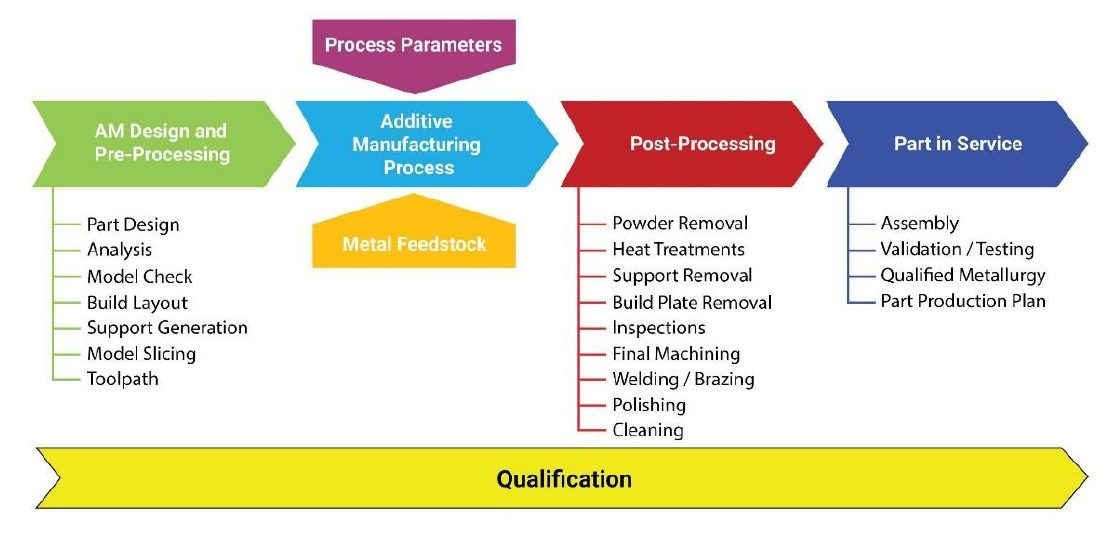
Source: Thakur et al. (2022)
In mechanical engineering, the strategic objective of additive manufacturing is to use the layer-by-layer approach to build and develop a novel product from scratch until its final completion. This differs from the traditional manufacturing methods that use subtractive methods like machining, mills, drills, molds and lathes as part of the processes of carving the product out of the solid block material (Hassanen et al., 2026). Quite often, the product is either drilled or heated and reshaped into the desired molds so as to create the final product. As heating, drilling and cutting are done to eliminate the unwanted parts of the materials, a lot of wastes tend to occur. This increases the overall product costs. Compared to additive manufacturing, this increases manufacturing costs. Additive manufacturing improves manufacturing efficiency. And it is because of such values that additive manufacturing is increasingly transforming the overall nature and approaches of mechanical engineering (Dasari & Xavior, 2026). In that transformation, the emergence of 3D design and printing has turned out to be quite transformational.
3D Printing and Mechanical Engineering
From the influence of additive manufacturing, it is now evident that in mechanical engineering, it has become the norm that the 3D Product Designs are developed and e-mailed for printing with precision. This improves manufacturing efficiency for more complex products that can be difficult to manufacture using the traditional manufacturing technologies of molding, cutting, milling or drilling (Botsalı & Özarpa, 2026). Because the product design is computer-based using computer-aided design and 3D Printing, the speed of product design, prototyping and development also improves. This improves the lead time which is the difference between the time that the product is designed, developed and delivered to the market. The shorter the lead time, the better for the manufacturing firms to gain from the first-mover advantages. It is therefore better for manufacturing firms to respond to the emerging new customer needs and demands before the other rivals are able to do so (Rouway et al., 2023). Though it emerged as a single theory, additive manufacturing or 3D printing has since evolved to be defined and explained by a combination of theories like Digital Representation and Slicing Theory, Thermodynamics and Solidification Physics, Mechanics of Materials, DfAM-Design for Additive Manufacturing, Process Classification/Seven Standard Families and Physics-Informed Machine Learning (Sanchez-Rexach et al., 2020). Digital Representation and Slicing Theory translates 3D CAD designs or the conceptual product design into the physical product layers ready for manufacturing using the designated machines.
Using boundary representation, facet approximation, toolpath generation, mathematical models, tessellations, conversion, normal vectors and mesh resolution, Digital Representation Theory seeks to convert 3D designs into layers ready for machine step-by-step building and development. Slicing Theory that explains mesh-to-toolpath conversion often uses intersection calculation, contour generation, infill generation and toolpath ordering to define how best the 3D designs can be seamlessly converted into the final product (Singh et al., 2020). Based on the designated slicing parameters, Slicing Theory discerns how the final product can be developed by building one layer and part after another without wasting resources or committing errors that affect product quality. It is in that way that 3D printing as part of additive manufacturing is influencing change and transformation in mechanical engineering.
Besides Digital Representation and Slicing Theory, additive manufacturing is changing and transforming mechanical engineering approaches using its theories on thermodynamics and solidification physics (Waddington, 2026). In the quest of building the final product layer by layer, additive manufacturing uses a lot of thermodynamics and solidification physics that deal with the process of heating and cooling different ingredients in order to translate the product into the desired shape and form. Solidification often uses two steps that encompass nucleation and growth. Nucleation is the development of the first solid particles from a liquid (Ben Said et al., 2025). This only occurs if the energy barrier is overcome by heating the object beyond the melting point in order to obtain the desired liquid-solid interface. Nucleation is divided into homogeneous and heterogeneous nucleation as well as critical radius. Homogeneous nucleation unfolds in bulk liquid after supercooling or getting undercooled. Heterogeneous nucleation that often unfolds on the existing surfaces requires limited supercooling. For critical radius, the nuclei or the tiny solid particles must reach a particular state in order to survive, while the smaller clusters melt back into liquid and the larger ones persist and continue to grow (Dubey et al., 2024). During growth, the stable nuclei build up as the solid phase grows as atoms link themselves with the liquid-solid interface.
Growth is explained by interface kinetics and heat-transfer-driven growth. Thermodynamics and solidification physics that explain the changes in the microstructure and the final mechanical properties of metals, semiconductors and alloys when heated argue that the process of liquid-to-solid change spontaneously unfolds when the temperature falls below the melting point. It is through thermodynamics and solidification physics that the industrial engineers are able to optimize material properties in different ways. In terms of casting and molding, thermodynamics and solidification physics are used for creating and building the desired structural metal components like engine blocks (Arefin et al., 2025). Since additive manufacturing deals with the development of more complex structures, the use of solidification in 3D printing tends to become essential for building complex parts of the product layer by layer. During the production of semiconductors, solidification often becomes essential for pulling single-crystal silicon ingots from melts that are sliced into microchips (Ma et al., 2023). Besides thermodynamics and solidification physics, additive manufacturing also uses mechanics of materials.
However, in additive manufacturing, the traditional mechanics of materials assumptions are altered due to the complex layer-by-layer aspects of the fabrication process. Mechanics of materials is the engineering science that elucidates concepts on how solid objects deform, stretch, bend and break if extreme forces are applied. Contrasted with physics or statics that consider objects as more rigid, mechanics of materials evaluates the internal distribution of forces and intensity of the object’s deformation if force is applied to the object (Ciccone et al., 2023). Core concepts in mechanics of materials include torsion, bending, axial and shear deformation, stress transformation, columns and buckling. If the manufacturers are not using mechanics of materials, they can utilize DfAM (Design for Additive Manufacturing), which has also in turn transformed the overall nature and approach of mechanical engineering.
DfAM and Mechanical Engineering
Using techniques or tools like topology optimization, lattice structures and part consolidation, DfAM often prepares and tailors the product for 3D printing and processing. Contrasted with the often stringent and rigid traditional manufacturing processes, DfAM often optimizes geometric freedom to utilize the available functions. It also seeks to eliminate weight and consolidate parts, while also operating within the designated physical parameters of the selected 3D printing technology (Goh et al., 2024). To enhance the efficient translation of the 3D product design into the final product, DfAM uses principles like self-supporting geometries, build orientation and anisotropy mitigation. In that process, it not only improves mass customization, but also weight reduction, delays and costs. DfAM applies software tools like DfAM, generative design and Finite Element Analysis (FEA). Generative design programmes use algorithms that aid the generation of nature-inspired images and shapes derived from the loaded information and the designated stress parameters. DfAM does the verification of whether the emerging models fit the 3D printing parameters prior to forwarding them to the printer (Raja et al., 2026). FEA (Finite Element Analysis) invokes the required mechanical properties to validate the strength of the model prior to printing.
Even if such a process aids the translation of the model into the required new products, the theory on Process Classification/Seven Standard Families has still emerged as the other theory influencing the effectiveness of additive manufacturing. Process classification deals with the classification of the production processes according to different categories. In that process, it argues that additive manufacturing is defined by seven standard manufacturing families that include additive manufacturing that does layer-by-layer building from 3D models, casting that deals with putting liquid into a mold cavity to solidify the liquid according to the desired shapes (Hassanen et al., 2026). Other families that are changing and transforming the overall nature of mechanical engineering include forming that alters the physical shape of the object using physical force that does not require the addition or removal of any material, joining that deals with fabricating or welding two objects together during the execution of the layer-by-layer building approach, and machining that deals with the drilling, removal, milling, turning or subtraction of any material in order to precisely create the required shape (Zarzoor et al., 2024).
Besides molding that deals with the injection and pressing of the designated material into a cavity, surface treatment is part of the seven families that deals with exterior modifications to improve the appearance, the properties and durability of the product. In addition to the seven families, process classification uses binder jetting, directed energy deposition, material extrusion, material jetting, powder bed fusion, sheet lamination and vat photopolymerization (Dasari & Xavior, 2026). Given the increasing advancement of artificial intelligence and machine learning technologies, the concept of physics-informed machine learning has also emerged to redefine how additive manufacturing is accomplished. In turn, these have also reshaped the overall nature of mechanical engineering. Physics-informed machine learning theory uses different AI-supported additive manufacturing tools like digital twins to build, develop and predict models that are more generalizable, physically plausible and require less data training.
In the machine learning algorithms, physics is integrated at three levels that include loss function modification, data curation and augmentation, and physics-based architecture design (Zargar et al., 2022). At each of these three levels, physics-informed machine learning theory may use any of the three approaches that include physics-informed neural networks, physics-consistent neural networks and physics-inspired architectures. Quite often, the use of these methods is often integrated with the common applications that encompass fluid dynamics, digital twins, material science and inverse problems. Quite often, physics-informed machine learning is preferred because it requires less data, enhances generalization and guarantees feasibility. It is such unique capabilities of additive manufacturing that have transformed the modern mechanical engineering approaches. For complex products that require different parts and materials, additive manufacturing improves multi-material and multi-functional printing during a single product build (Botsalı & Özarpa, 2026). The multi-material elements of additive manufacturing enable the creation of a composite structure that has different properties, flexibility, stiffness, conductivity and thickness within the same product component.
The multi-functional printing of additive manufacturing enhances the integration of additional functions into the 3D printed products. To achieve this, it improves the embedding of actuators, sensors and electronics into components during printing. In mechanical engineering, this eliminates the degree of product complexity and the need for assembly (Rouway et al., 2023). By integrating the assembly functions, it reduces product complexity to improve the efficiency and ease of the product manufacturing processes. After printing, additive manufacturing technology has also improved to execute the resolution and surface finishing functions. In the way that has changed and transformed the nature of mechanical engineering, additive manufacturing uses post-processing techniques like machining, surface coating and polishing to enhance the mechanical properties of 3D-printed products and surface finish. In the process that has transformed mechanical engineering, additive manufacturing often uses a combination of tools like fused deposition modelling, stereolithography, selective laser sintering, metal 3D printing and binder jetting (Sanchez-Rexach et al., 2020). Fused deposition modelling is often preferred for creating rapid prototypes and functional parts.
Using this technique, the thermoplastic filament is usually melted and extruded using a nozzle to enhance the layer-by-layer building of the objects. Using the layer-by-layer approach, stereolithography uses a laser to cure and harden a liquid resin. The technique is preferred because of its precision and the essence of its applications in areas requiring intricate details. Selective laser sintering on the other hand uses a laser to fuse powdered material layers. It is usually preferred for producing components that have complex geometries. It is also advantageous for the reason that it often uses various forms of materials like metals and plastics (Singh et al., 2020). While metal 3D printing uses metal powders, binder jetting is usually used for creating prototypes and functional parts that improve the cost-effectiveness of the mechanical engineering operations. In that process, additive manufacturing is also using Diabatix to influence the increasing roles of additive manufacturing in mechanical engineering (Yadollahi & Shamsaei, 2017). It seeks to address some of the common challenges of mechanical engineering by using generative design for precision, thermal analysis for improved quality and greater material freedom.
CONCLUSION
The thin line between mechanical engineering and additive manufacturing is increasingly becoming blurred as additive manufacturing gets to be regarded as the best-known aspect of mechanical engineering. This is because of the cost, efficiency, quality and waste minimization values that additive manufacturing has introduced into mechanical engineering. Compared to the traditional manufacturing approaches, additive manufacturing emphasizes the precision of the steps that keep on adding one material and layer after another until the final product is developed. This reduces wastes. It reduces costs, while also improving the efficiency of mechanical engineering. It is such values of additive manufacturing that have redefined the nature of mechanical engineering as compared to the traditional manufacturing approaches. Reduced wastes eliminate costs to in turn bolster the mechanical engineering business’ improved cost competitiveness. Additive manufacturing is not only the future of mechanical engineering, but also business sustainability. It not only aids cost minimization, but also improved quality management. However, additive manufacturing is still affected by technical limitations like build volume restrictions, surface finishing and post-processing limitations, and batch-to-batch material property variations. Besides quality control issues, additive manufacturing is also affected by the hefty initial investment and maintenance costs and software incompatibility issues. For that reason, further research ameliorating these deficiencies is therefore essential for improving the efficacy of additive manufacturing to continue driving mechanical engineering’s change and transformation.
References
Anderson, D. (2024). Evolution and impact of mechanical engineering in modern technology. Journal of Applied Mechanical Engineering, 13, 511.
Arefin, N., Moni, H.-E., Espinosa, D., Cong, W., & Zeng, M. (2025). Multi-material additive manufacturing of energy storage and conversion devices: Recent progress and future prospects. Applied Physics Reviews, 12(1), 011330. https://doi.org/10.1063/5.0244376
Ben Said, L., Ayadi, B., Alharbi, S., & Dammak, F. (2025). Recent advances in additive manufacturing: A review of current developments and future directions. Machines, 13(9), 813. https://doi.org/10.3390/machines13090813
Botsalı, H., & Özarpa, C. (2026). Optimization of the design and manufacturing processes for metal additive manufacturing through digital twin. Processes, 14(3), 571. https://doi.org/10.3390/pr14030571
Ciccone, F., Bacciaglia, A., & Ceruti, A. (2023). Optimization with artificial intelligence in additive manufacturing: A systematic review. Journal of the Brazilian Society of Mechanical Sciences and Engineering, 45, 303. https://doi.org/10.1007/s40430-023-04229-5
Dasari, J., & Xavior, M. A. (2026). Review of additive manufacturing and post processing techniques for aluminium alloys with focus on microstructure changes, mechanical performance and emerging trends. Discover Mechanical Engineering, 5, 48. https://doi.org/10.1007/s44245-026-00189-9
Dubey, D., Singh, S. P., & Behera, B. K. (2024). A review on recent advancements in additive manufacturing techniques. Proceedings of the Institution of Mechanical Engineers, Part E: Journal of Process Mechanical Engineering. Advance online publication.
Goh, G. D., Wong, K. K., Tan, N., Seet, H. L., & Nai, M. L. S. (2024). Large-format additive manufacturing of polymers: A review of fabrication processes, materials, and design. Virtual and Physical Prototyping, 19(1), e2336160. https://doi.org/10.1080/17452759.2024.2336160
Hassanen, S. M., Seid Ahmed, Y., Al Momani, B., & Milani, A. (2026). A review of additive manufacturing techniques for wind turbine blade production: Capabilities, AI integration, and scale-up potential. Frontiers in Mechanical Engineering, 12, 1781579. https://doi.org/10.3389/fmech.2026.1781579
Horner, H. (2025). How 3D printing impacts 3 popular fields of engineering. Engineering Institute of Technology. https://www.eit.edu.au/how-3d-printing-impacts-3-fields-of-engineering/
Ma, L., Yu, S., Xu, X., Amadi, S. M., Zhang, J., & Wang, Z. (2023). Application of artificial intelligence in 3D printing physical organ models. Materials Today Bio, 23, 100792. https://doi.org/10.1016/j.mtbio.2023.100792
Pathapalli, V. R., A. C. U. M. R., Kasu, S. R., S. T., & Doni, M. K. (2026). A review on additive manufacturing: Its applications and future directions. Rapid Prototyping Journal. Advance online publication. https://doi.org/10.1108/RPJ-10-2025-0497
Moorthy, A. (2024). Advancements in additive manufacturing: Revolutionizing mechanical engineering. Bannari Amman Institute of Technology. https://www.bitsathy.ac.in/blog/advancements-in-additive-manufacturing-revolutionizing-mechanical-engineering/
Raja, C. P., Sridevi, G., Pandipati, S., Satthiyaraju, M., Parrthipan, B. K., Shanmugam, V., Aseer, R., Babu, S., Mensah, R. A., & Babu, N. B. K. (2026). Sustainable additive manufacturing of polymers and composites: Optimization of nozzle design, printing parameters, and post processing for waste to value transformation. Frontiers in Chemical Engineering, 8, 1732573. https://doi.org/10.3389/fceng.2026.1732573
Rouway, M., Tarfaoui, M., Chakhchaoui, N., Omari, L. E. H., Fraija, F., & Cherkaoui, O. (2023). Additive manufacturing and composite materials for marine energy: Case of tidal turbine. 3D Printing and Additive Manufacturing, 10, 1309–1319. https://doi.org/10.1089/3dp.2021.0194
Sanchez-Rexach, E., Johnston, T. G., Jehanno, C., Sardon, H., & Nelson, A. (2020). Sustainable materials and chemical processes for additive manufacturing. Chemistry of Materials, 32, 7105–7119. https://doi.org/10.1021/acs.chemmater.0c02008
Sanz, J. L. M., et al. (2009). The evolution and development of mechanical engineering through large cultural areas. In H. S. Yan & M. Ceccarelli (Eds.), International symposium on history of machines and mechanisms (pp. 69–81). Springer. https://doi.org/10.1007/978-1-4020-9485-9_6
Shah, A. (2026, June 11). Latest advances in mechanical engineering (2026). SimuTecra Engineering. https://simutecra.com
Shigley, J. E., Mischke, C. R., & Budynas, R. G. (2011). Mechanical engineering design (9th ed.). McGraw-Hill.
Singh, U., Lohumi, M., & Kumar, H. (2020). Additive manufacturing in wind energy systems. In A review (pp. 757–766). https://doi.org/10.1007/978-981-15-2647-3_71
Thakur, V., Roopkaran, S., Kumar, R., & Gehlot, A. (2022). 4D printing of thermoresponsive materials: A state-of-the-art review and prospective applications. International Journal on Interactive Design and Manufacturing (IJIDeM), 1–20. https://doi.org/10.1007/s12008-022-01018-5
Waddington, S. (2026). The evolution of additive manufacturing. International Metal Sheet Review.
Yadollahi, A., & Shamsaei, N. (2017). Additive manufacturing of fatigue resistant materials: Challenges and opportunities. International Journal of Fatigue, 98, 14–31. https://doi.org/10.1016/j.ijfatigue.2017.01.001
Yap, C. Y., Chua, C. K., Dong, Z. L., Liu, Z. H., Zhang, D. Q., Loh, L. E., et al. (2015). Review of selective laser melting: Materials and applications. Applied Physics Reviews, 2, 041101. https://doi.org/10.1063/1.4935926
Yadollahi, A., & Shamsaei, N. (2017). Additive manufacturing of fatigue resistant materials: Challenges and opportunities. International Journal of Fatigue, 98, 14–31. https://doi.org/10.1016/j.ijfatigue.2017.01.001
Zargar, O. A., Lin, T., Zebua, A. G., Lai, T.-J., Shih, Y.-C., Hu, S.-C., et al. (2022). The effects of surface modification on aerodynamic characteristics of airfoil DU 06 W 200 at low Reynolds numbers. International Journal of Thermofluids, 16, 100208. https://doi.org/10.1016/j.ijft.2022.100208
Zarzoor, A., Jaber, A., & Shandookh, A. (2024). 3D printing for wind turbine blade manufacturing: A review of materials, design optimization, and manufacturing processes.
Zheng, H., Zhu, S., Chen, L., Wang, L., Zhang, H., Wang, P., et al. (2025). 3D printing continuous fiber reinforced polymers: A review of material selection, process, and mechanics-function integration for targeted applications. Polymers, 17(12), 1601. https://doi.org/10.3390/polym17121601